
by Jenny Golding, Jenny Trigwell & Janice Calcei
Updated: 19 February 2025
If you have information and photographs of other homesteads or houses of interest in Dardanup, built up until 1950, please let us know by using the Contact Us page.
Dardanup Park
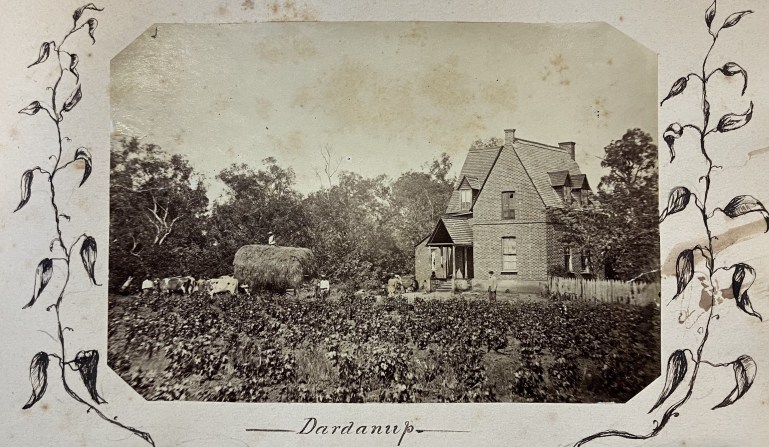
Dardanup Park was built in 1852, from bricks manufactured on the site, for Thomas and Eliza Little. It is the earliest homestead in Dardanup although not its earliest building. The Rev. John Wollaston and his sons built at least one smaller cottage on the same land when they were farming it in the early 1840s, when it was known as The Pools. It seems likely that other cottages were also being built around 1850 as Irish migrants, escaping famine in their homeland, began moving to the area with the encouragement and support of Thomas and Eliza Little, to become tenant farmers of the Littles. There were also buildings at Prinsep Park before the main homestead was built.

Thomas and Eliza and their family took up residence at Dardanup Park in 1854, after moving from Belvidere on the coast north of Bunbury where they had been managing Charles Prinsep’s estate.
Dardanup Park was later purchased by George Shenton Snr in 1867, when Thomas Little was facing bankruptcy, however Shenton drowned shortly afterward on 5 March 1867 in the shipwreck of The Lass of Geraldton while travelling from Perth to Bunbury.
Dardanup Park remained in Shenton’s estate until 1877/78, when it was either inherited or purchased by Henry Whittall Venn who had married Shenton’s daughter Charlotte in 1874.
The house and property were subsequently taken over by Frank Evans Venn, H W Venn’s nephew, after his uncle’s death in 1908. His son, also Frank, and his wife Zoe sold the house and remaining Dardanup land to the Baskott family in 1972.
The building, much enlarged in the late 1800s, remains standing.
Click here for more on the story of Thomas and Eliza Little.


Killarney
The Garvey family from Hollyford in County Tipperary, Ireland, sailed into the Swan River Colony on the ship Clara and were in Dardanup when Bishop Salvado wrote their names on the list he made in 1854 of Catholic settlers in Dardanup. Garveys named on that list were William and Mary (nee McHugh) and their children, Patrick, Timothy, Alice, Margaretta and Mary.

The Garveys settled originally on two small blocks. Both acreages were close to the Littles at Dardanup Park and were on small tracks off what is now Venn Road. Venn Road was not then much more than a track and was part of the coach and cart way Bunbury to Dardanup and beyond. Venn Road was originally Garvey Road. The family was welcomed to the area by Irish couple Thomas and Eliza Little, who were encouraging Irish newcomers to take up small or larger blocks and to become self-sufficient.
The house was typical of Irish homes in the area except that the Garveys, instead of forming walls with wattle bough uprights, used battens, sawn in pits on their land. The smooth side of the battens formed the outside of the house, meaning the rougher side could be used to hold mud and sand, which hardened strongly, to form the interior wall. A veranda gave protection. Battens were also used in the roof, originally holding shingles made on the property and later, galvanised iron. There were several bedrooms but extra rooms were made by enclosing the side verandas and larger windows were a further alteration. In early days, the kitchen with an oven was away from the house for fire-safety but an open fireplace at the far end of the living room warmed the home and family in winter. Typically, there was an Irish mantlepiece high over the fireplace; covered with a crochet-edged cloth and proudly displaying precious keepsakes from Ireland.
Killarney became one of the properties in the sub-division of Padbury Fields, Dardanup.
Click here for more about Killarney and the Garvey family history: Killarney or William and Mary Garvey.
Rosevale
The original Rosevale cottage was built by James and Alice Cleary (nee Garvey) in the 1860s. It was a wattle and daub thatched cottage typical of homes built by Irish migrants who settled at Dardanup at that time.
James and Alice married in the first Catholic Church in Dardanup (now the Thomas Little Hall) in 1861. At the time, James was working for Thomas Little at Dardanup Park. Their eldest daughter, Mary Ann was born in 1862. In 1865 James bought land, in the vicinity of what is now Cleary Road, from early settler James Hertnan. Daughters Margaret and Alice were born there.

(Image courtesy Amelia Kalaf)

Mary Ann became the teacher at the Dardanup State School from 1882. Tragedy struck the family when James Cleary died in 1902. His son-in-law, David Shaw, married to Mary Ann’s sister Alice, was working away and unable to help on the family property so Mary Ann resigned from teaching to manage the farm. When David Shaw died in 1908, Mary Ann became the bread-winner for a household which included her widowed mother, widowed sister and Alice’s daughter Mary.
The old cottage was replaced with a more modern timber cottage in the 1920s and the name of Rosevale was retained. Mary Ann continued to live there until her death in 1937. Rosevale remained in the family until the early 2000s and still stands today.
Click here for more on the story of Mary Ann Cleary.
The Poplars
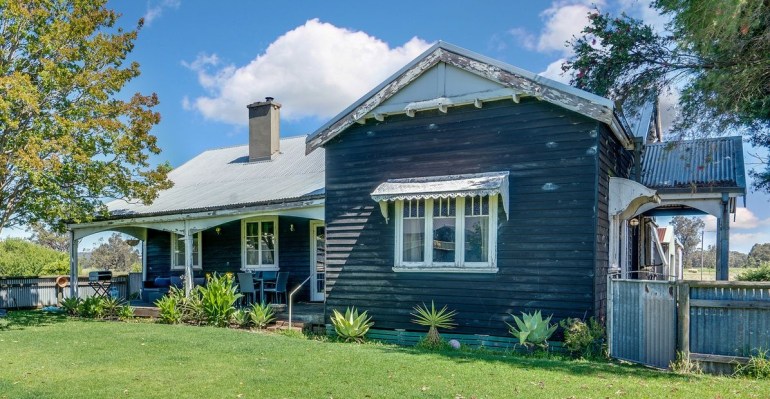
Built in Dardanup in the early 1860s along the road to Ferguson, The Poplars, home to the Irish Maguire family, became the town’s first Post Office and a staging post for teamsters and bullocks carting timber from Wellington Mills to build the Bunbury Wharf.
John and Catherine (nee McGuiness), Maguire arrived into the Leschenault Estuary, Bunbury, in 1842 aboard the Trusty. With them were John’s parents, James and Ann, and John’s 12-year-old brother, James.
John Maguire became the area’s first Postmaster in October 1867, supported undoubtedly by his busy family. The Post Office was in a room and enclosed veranda of their two-storey house. Mail came and went with men on horseback, letters and parcels moving between Bunbury and Donnybrook/Bridgetown.
Catherine died on 12 September 1875 when she fell down the house stairs and her lantern burst into flames, causing dreadful upper body burns.
John ceased as the Postmaster in 1877 and, on 31 January 1882, offered the property for sale.
The property was bought by Frank de la Motte Johnston (son of Harley R. Johnston and Mary Louisa Clifton) and his wife, Elizabeth (Victor). Frank and Elizabeth Johnston had six children.

Daughter, Amy Johnston, married Jasper Hyde Brett in 1908 in Dardanup and the marriage and reception were held in the garden and house. Frank died in 1920.
The Richards family bought The Poplars in June 1920. In more recent times, it has been the home of the Italiano family.
Click here to read more on the history of The Poplars and for a detailed description of the original house.

Roseland
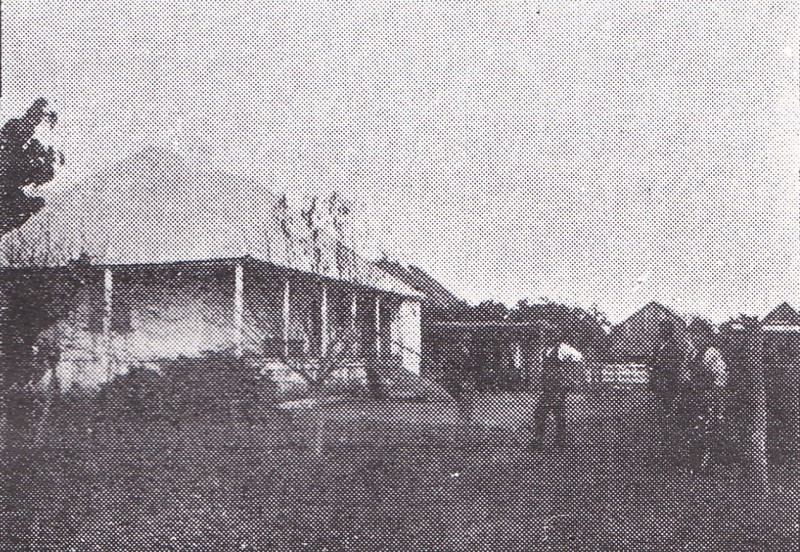
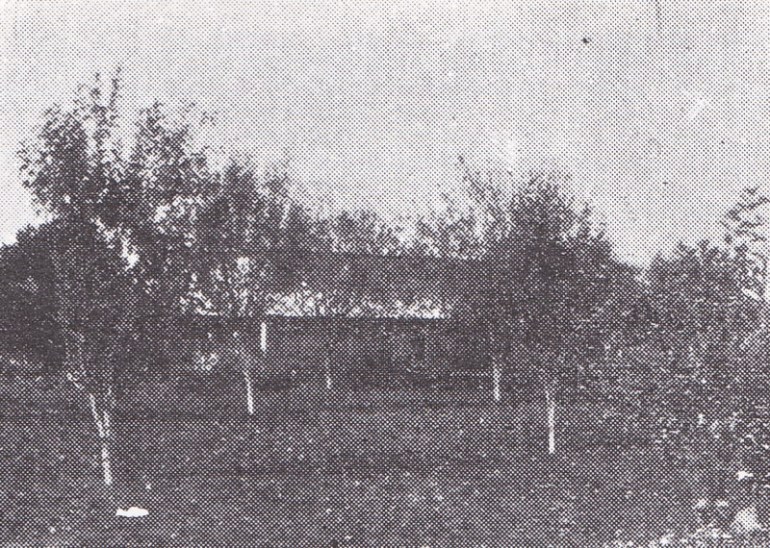
Roseland was purchased in 1871 by Forbes and wife Margaret (nee Garvey) Fee. Their great-grandson, Neville Hislop, was told the house was built by Thomas Little for early settler James Hertnan. James Hertnan was an ex-private of the 21st Fusiliers and one of the first settlers in little Irish community established by Thomas Little in Dardanup.
Forbes Fee had been a police officer until he took up farming at Dardanup. When he purchased Roseland the homestead comprised two main sections. The larger section had an underground cellar and the rooms overhead were known to the family as “up above”. This area was divided into bedrooms and on the outside was surrounded by a verandah.
The adjoining building was the kitchen and this included a long table where meals were prepared and eaten. At times the kitchen was cleared for dances to be held. In a separate section was a small parlour for more formal occasions. (Fee’s Dardanup Diaries, Vol 2 (2002), Notes from Neville Hislop).
The home was photographed and described in 1901 for the book Twentieth Century Impressions of WA.
Roseland, the property of Mr F Fee, is situated in the Dardanup district, and comprises an area nearly 1500 acres in extent. The nucleus of this valuable property was acquired by Mr Fee thirty years ago, when he purchased some 65 acres. To this he has consistently added each year, until he now owns a property of great value. The property is now farmed by the proprietor’s two sons, who have leased it from Mr Fee.
Twentieth Century Impressions of WA, pp. 555-556
There are 300 acres cleared, and about 100 acres are annually cropped. To this the Messrs Fee have added on their own account by right of purchase some 300 acres. As is universally done in the south-west, Messrs Fee engage in “mixed” farming, the average yields from various crops being as follows: – Hay, a ton to the acre; oats 20 bushels; wheat, 13 bushels; and potatoes, 6 tons. The property carries about 100 head of store cattle, while horse-breeding is also carried on, and pigs are dealt in a small way.
There is a splendid orchard on the property. Two dwelling houses have been erected on the homestead block and the outbuildings comprise two hay sheds, with a capacity for 200 tons; stables for the accommodation of seven horses, machinery shed, and smith’s shop.
Click here for more on the story of George Fee and the Diaries he wrote from the age of 16 years of age in 1886, until just before his death in 1942.
Click here for more on the story of James Hertnan
Hayward’s House
Terry and Geraldine Hayward moved into their newly built home, on what is now Hayward St, in 1928. Terry Hayward had been the Principal at Dardanup State School from 1911 and became Secretary of the Dardanup Roads Board in 1913.
A small room was built onto the side of the house which served as the Roads Board offices. Terry Hayward worked there as Secretary of the Dardanup Roads Board until the new offices were built and officially opened by him on April 20, 1950. He retired in 1951.
The house was demolished in 1971. Click here for more on the story of Terry Hayward.

References:
- Twentieth Century Impressions of WA (1901), P W H Thiel & Co, Perth, reprinted by Hesperion Press (2000), Perth Western Australia
 Dardanup Heritage Collective