
by Janice Calcei
Updated: 11 November 2025
By the commencement of World War I in 1914, the town of Dardanup had evolved from its colonial beginnings, surviving the trials of early settlement to become an important transport hub for local timber and agricultural industries.
The first inhabitants of this area were the Nyoongar people of the Wilman, Kaneang and Wadandi language groups. They lived from, and travelled across this land; towards the coast in the warmer months and inland in the cooler months, always near waterways. Nyoongar people cared for the land, burning country as they went to encourage new growth and attract game like yongka (kangaroos) and kwer (wallabies).
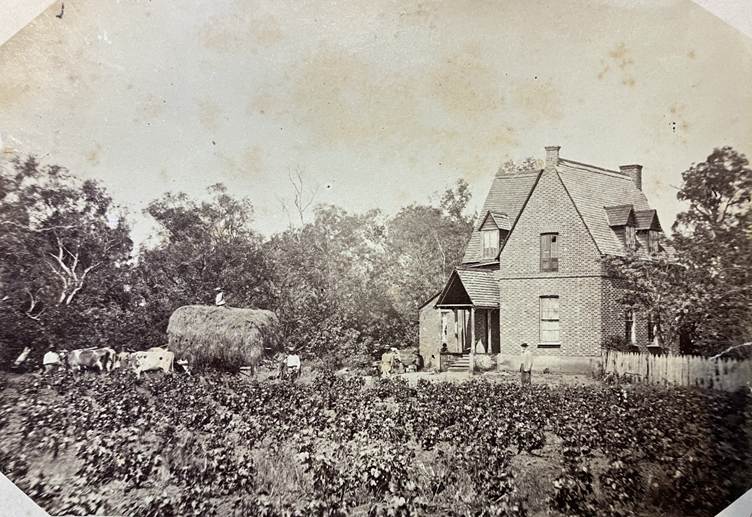
European settlement around Dardanup began in the early 1840s when the Reverend John Wollaston and his sons farmed an area known as The Pools. From that time until the end of the nineteenth century, Dardanup’s economy was driven by a few large landholdings alongside smaller holdings taken up by migrants. From 1838 Charles Prinsep, through his agent Thomas Little, purchased over 20,000 acres of land in the area to breed horses for the Indian market. These properties were later run by his son Henry Prinsep who sold them to Henry Venn in 1877.
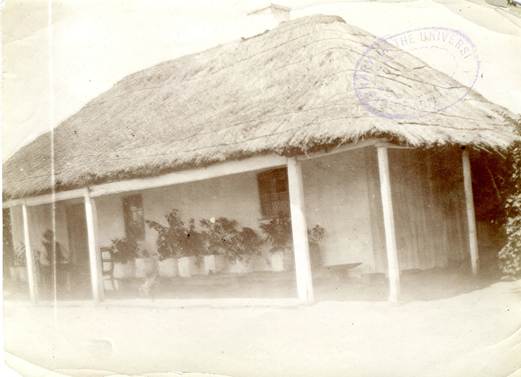
Thomas Little, an Irishman, purchased properties of his own. One would become Dardanup Park. From the late 1840s, Thomas and his wife Eliza supported Irish migrant families to settle on small blocks of land as tenant farmers in and around what is now the town of Dardanup. For much of the 1800s these smallholders subsisted off their land. Many lived in timber homes or whitewashed and thatched cottages, reminiscent of Ireland.
Aside from horse and cattle breeding on the larger holdings, sheep, fruit, vegetables, potatoes, wheat and grapevines were grown on Dardanup farms.
Thomas Little established a strong Catholic community at Dardanup providing land and building materials in 1852 to construct the first Catholic church outside Perth. He also built the town’s first school next to the Church. In the late 1800s and early 1900s, Italian migrants also began moving to the area.
A significant change occurred at Dardanup when the Bunbury to Boyanup rail line opened to locomotives in 1891 and the Bunbury to Perth line opened in 1893. Ready rail transport presented new business opportunities.
From 1896 the Canning Jarrah Timber Co. set up a large timber operation at Wellington Mills, accessed by rail, 19 kilometres east of Dardanup. Large storage yards, where sawn timber awaited transport to Bunbury port for export, were established at Dardanup. This was a turning point for Dardanup as many timber workers moved to the area.
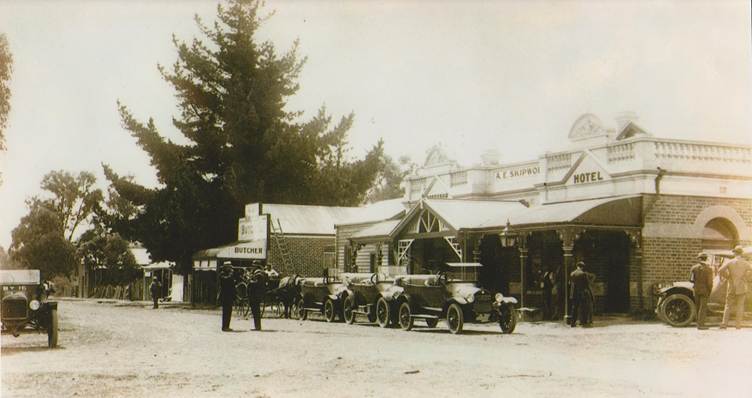
By 1914, thanks these events, a town had formed along Charlotte St parallel to the railway line. The business life of the town was somewhat unusual as most operations were run by women, descendants of the first Irish settlers; the Dardanup Hotel by licensee Ellen Skipworth (nee Coonan), the general store by Catherine Prout (nee Slattery) and the Post Office from about 1905 by Mary Coonan (later Mary Holland).
A butcher’s shop was built on Charlotte St in 1908 for Morrissey Bros, a well-known butchering business owned by the George Henry, John Patrick, and Richard Morrissey. In 1916, Dardanup would also become the site of large livestock saleyards, built to take advantage of ready rail transport to Bunbury and Perth.
According to diaries of George Fee, a Dardanup farmer, social life in the town was very lively. Even prior to the building of the Dardanup Agricultural Hall in1894 dances, socials, fundraisers and card nights were regularly held in private homes. The Catholic community remained strong in the town and the Church and presbytery were a focus of community and social activity.
The school set up in 1854 by Thomas Little, first at his home and then in a dedicated building, was taken over by the State government in 1880. A new public school was built and opened in 1897. In 1914, this was the only school in Dardanup although the Sisters of Mercy re-established Catholic education in Dardanup in 1920. From that time there would always be two schools.
Dardanup’s population in 1856 was 110[3], with 75 of those recorded as Catholic or as tenants of Thomas Little. Fifty years later in 1898 the population was still only 118[4]. By 1914 it was likely higher because of timber industry workers and probably around 150.
When enlistees left Dardanup for World War I, thanks to the hard work and initiative of its early settlers, Dardanup had become a relatively sophisticated and connected community with a railway station, telegraph and postal services, thriving businesses and an active social scene. It would have been a beloved home for those who served.
[1] An Irish cabin Dardanup, WA 1901 – the builder and thatcher Mr Cleary, is by the door, Daisy Bates Digital Archive, University of Adelaide
[2] Dardanup Park 1873, Battye Library, MN 120, Charlotte Venn diaries and photographs, call no. ACC1193A
[3] Salvado’s list of Catholics in WA, 1854 – Battye Library call no. ACC 2398A
[4] Western Mail, Friday 22 April 1898, page 20
[5] South Western Times, May 1, 1984
 Dardanup Heritage Collective