
by Jenny Golding
Updated: 4 March 2025
Home-made bricks, fashioned from clay on their property at Crooked Brook, Dardanup, were used to build a house for Frank Dillon’s ancestors; a home in which Frank lived, as a lad, for many years before moving to work at Rottnest and in Perth.
He married Doris Adamson in Perth in 1934 and the couple came to the old house in 1938 to farm and raise their children.
Frank said that the home consisted of three rooms, two as bedrooms and one as a living room and the walls were protected by all-around verandas. A galvanised iron roof gave extra protection. Timber face-cuts were used to enclose portions of the verandas when additional sleeping space was needed. A kitchen, with an oven, was built separately.
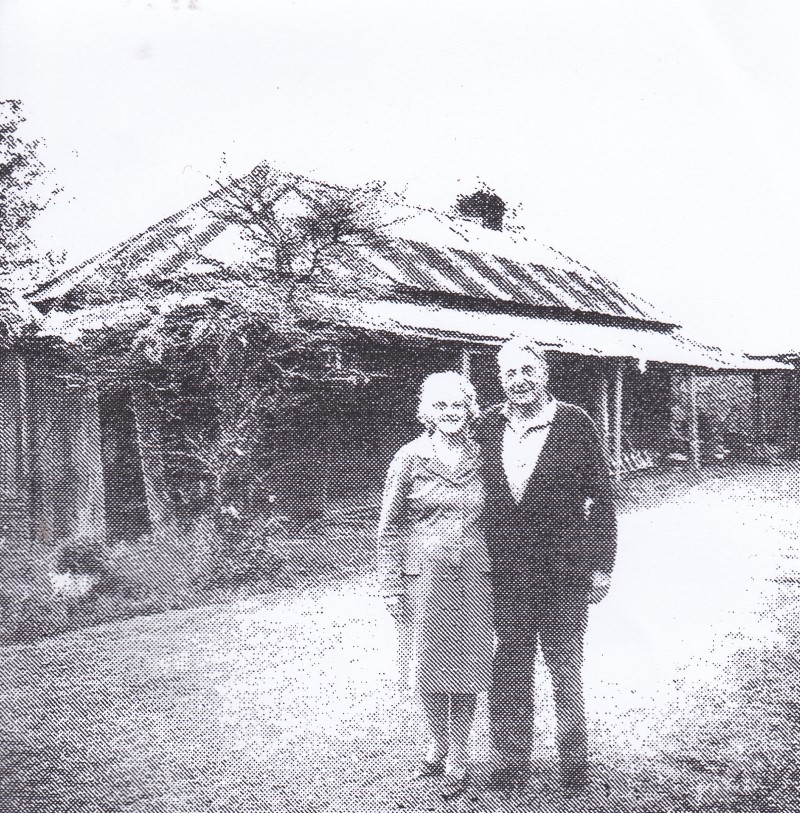
Frank and Doris were aged eighty and seventy-four, respectively, and living in a new home on the property when this photograph was taken in 1984. They had recently celebrated their Golden Wedding Anniversary.
One of the first Dillon family members in Crooked Brook was Richard who had been born in Ireland in 1830. He sailed to the Swan River Colony in 1850 and was welcomed to the Dardanup district. Neighbouring families in Crooked Brook included the Hertnans and the Doolans.
In 1851 Richard married Maria Hertnan and Thomas, Maria and Ellen were born to them before Maria died at the age of twenty three.
Richard married Ann McKinley in 1860, school teacher at the little Catholic School in Dardanup. Arthur, father to Frank, was born of this second marriage.
Richard Dillon died in 1872. In 1874 widowed Ann married James Doolan who farmed 100 acres in Crooked Brook. Four children were born. Ann Doolan (McKinley/Dillon) died in Perth in 1918.
Mrs Doolan was the first lady school teacher to go to Dardanup about sixty years ago. She was educated at the Convent of Mercy, Victoria Square, by the late Mother De Sales and practically all her life was spent at Dardanup where she was held in high esteem by all her knew her.
Daily News Perth Monday 22 July 1918 P 4 (in part)
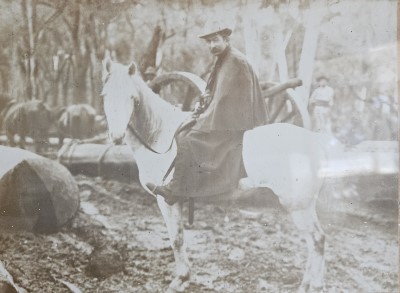
Arthur Dillon married Laura Mary Brennan in Toodyay in 1897 and the couple lived in Jarrahdale where Arthur worked in the timber industry and where ten children were born. The family moved to the old Crooked Brook home in 1912 and another two children were added to the family there. The children were Mabel, Olive, Annie, Edward, Frank, Austin, Herbert, Alice, Jack, James, Allan and Vernon.
Just two years later, tragedy struck. Arthur was crushed while taking a dray load of bagged chaff into Dardanup. Three horses pulled the dray but the load shifted as the Crooked Brook railway line was crossed and Arthur was thrown to the ground. The horses bolted and the dray passed over him. Laura was following in a spring cart, young children with her. Frank was taken to Bunbury hospital but died on March 4 1914. Grieving Laura was faced with farming responsibilities and the care of their many children. Fortunately, the older children and her father, James Brennan, son of Peter and Patience Brennan of Wonnerup and well-known in Dardanup, stepped in to help.
Laura is said to have grown rhubarb to be sent to Perth, sometimes making a little money but perhaps just receiving a cartage bill. It is believed she moved to Bunbury when Frank and Doris came to the farm and died in 1957. She and her husband are buried in the old Catholic Cemetery in Dardanup.
Remembering his early days at Crooked Brook, Frank said the farm and house were still without electricity and running water when he returned to the property. He added that his family had always drawn water in buckets from a well close to the creek, their only source of water.
Washday saw the women of the family working under a peppermint tree, boiling water and clothing in a four gallon drum, using a scrub board and two kerosene tins for washing. They were devastated when, as sometimes happened, the drum became unbalanced on the wood fire and toppled sideways . Sometimes the clothes line, attached to trees, broke suddenly spilling clean, flapping laundry to the ground. Clothes and hearts plummeted.
Bread was baked every day for large families and every second day for smaller.
Cows were milked by hand, the milk separated and churned for cream or butter. Much was needed by the family. Pigs and poultry added to food supplies.
When a baby was due, the doctor in Bunbury was called from the telephone box at the Dardanup Railway Station and would arrive with horse and buggy. Children remember that the fee of three guineas was always set on the mantlepiece to be taken as the doctor left.
Children travelled to school in a spring cart or simply walked.
References:
- Notes: Jenny Trigwell
- Notes and interviews: Gwen Wells
- 1988 Interview: Frank and Doris Dillon, by Jenny Golding
Image:
- Photograph of Arthur Dillon provided by Jenny Trigwell
 Dardanup Heritage Collective