
by Janice Calcei
Updated: 20 August 2025
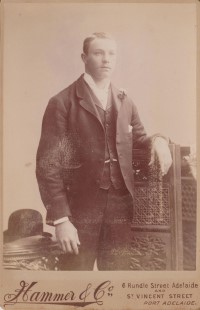
There is no published obituary for James Owen Gardiner, but after his death in August 1950, the Dardanup Rifle Club Report published in the South Western Times, on 31 August 1950 noted that:
“During the noon recess the captain expressed in a few well chosen words, the club’s sympathy to Mr Ralph Gardiner for the loss of his father. The late Mr James Gardiner was loved by all; his sterling qualities and beautiful nature encouraged all to try and emulate his outstanding character. One minute’s silence marked the sympathy shown by all present.”
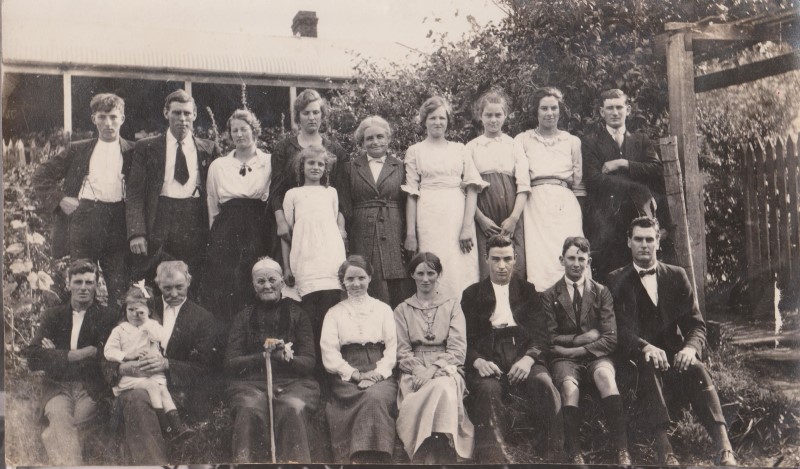
James Owen Gardiner was born on 8 April 1870 in Ferguson, Western Australia. He grew up at Mountain Spring farm and died on the farm next door, Hill View, in 1950 living his entire life within a few hundred metres of his birth place. His father, Owen, was 31 and his mother, Emma (nee Gibbs) was 24 years of age. When James was 25, he married Johanna Ali on 13 February 1895 at Ferguson. They had five children in 11 years.
James’ grandparents, Jesse and Jane (nee Butt) had married in Bisley, Gloucestershire in 1832. His father Owen Gardiner was born in Bisley in 1839.
Jesse and Jane Gardiner signed up to be part of a settlement scheme being run by the London based Western Australian Co. to establish the township of Australind on the Leschenault Estuary near Bunbury. The couple and their four boys emigrated to Western Australia, arriving at Bunbury on 6 December 1842 aboard the ship Trusty.
Jesse migrated as a labourer, a sawyer, rather than as a land-purchasing settler, securing free passage for himself, his wife Jane and their four children. Their fares would have been paid by a wealthier settler. Settler migrants paid £100 for fares for their own families, for the right to be granted land when they arrived, and to cover the cost of fares for labourers, like Jesse Gardiner, and their families to come to Australia. The settlement needed capital as well as labour to succeed.
The scheme intended to take up the 100,000 acres of land around what is now Harvey and Australind, the former Latour grant awarded by the colonial government in 1830, but by 1840 still undeveloped and about to be resumed by the government.
A number of poor decisions by the Western Australian Company, including the last minute possibility of moving the entire settlement to Port Grey, as well as the threatened resumption of the grant by the colonial government, led to a loss of confidence by investors in the scheme.
Slow communications between Australind and the Company contributed to the scheme’s demise as did economic uncertainty in England in 1840-41 with the bankruptcy of Wright and Company, the Company’s Banker. Investors withdrew capital and prospective investor settlers were put off.
The company was winding down in early 1843 and by the time the final few Australind migrants arrived aboard the Trusty’s second trip in 1844, 464 people had already travelled to Australind. There were too few settlers with capital to provide paid work and too many labourers. Most of these migrants eventually left the settlement to find work elsewhere in the colony.
Jesse Gardiner and his family persisted at Australind. It is likely he found work in and around the settlement and then for Marshall Waller Clifton, the Chief Commissioner for the Western Australia Company. Jesse was rewarded in 1854 by gaining the occupancy of land in the angle made by the junction of the Wellesley and Brunswick Rivers at the very western end of Melville Road. His son Bradley settled on this Brunswick farm while Jesse himself transferred his interests to land on the Ferguson River just before 1850, the first of many to settle in the area.
On a survey sheet in 1844, surveyor Henry Mortlock Ommanney remarked that the Ferguson River, “flows through property surveyed for Dr. John Ferguson”. The long valley into the hills east of Dardanup took its name from the river. Jesse and Jane Gardiner were the first European settlers on the Ferguson River.
Jesse and Jane would have travelled out to Ferguson before taking up their grant. They chose good land but, as was usual in England, only applied for small lots sizes, 10-20 acres, before realising they needed larger blocks of land to survive in Australia. Other settlers who came to the Ferguson at this time were E Higgins and J Hough.

Jesse and Jane built a farm house, “Blackberry Valley” in a pattern common among settlers with a main rectangular cottage, possibly of brick, whitewashed, and likely with two rooms, closed in verandahs of timber at each end of the house, and a timber shingle roof.
Jesse donated land for the Ferguson cemetery with the first graves dating from 1850. His youngest son Ephraim Gardiner donated land for the building of the first Ferguson Church in 1879.
Tenders published in the newspaper show Jesse delivered the colonial mail between Bunbury and Dardanup, and vice versa, twice a week on horseback in 1867 for £38 per annum. This would have been a significant supplement to farm income at the time.
Jesse and Jane Gardiner’s son, Owen Gardiner, married Emma Gibbs in 1866. They purchased Mountain Spring Farm, along the Ferguson Road in 1867 and this is where their eldest son, James Owen Gardiner was born and raised.
Emma was remembered in the family as being physically strong, and a hard worker, able to do as much as men on farm. She was also quick to tell others they were not doing enough!
The Ferguson Road was then known as Kojonup Road and was the main route from Bunbury and Dardanup through to Lowden, Boyup Brook and on to the Great Southern. Jane died in 1885 and Jesse in 1893. Both are buried in the Ferguson Cemetery. Gardiner descendants still farm in the valley today.
Jim Gardiner’s grandson, Kevan Stone, remembers Jim telling him, that between the 1840s and 1870s, when his father Owen was a young man, a family group of about 30 aboriginal people still travelled through the Ferguson Valley about twice a year; journeying back and forth between Dardanup, Bunbury and towards the Albany area.
This was likely the Kaneang people of the Nyoongar nation whose migratory route included Ferguson. They would only have travelled south east to the limits of their land in winter, around Mt Barker, so not as far as Albany. The land around Albany was the traditional country of the Menang people. The Kojonup Road was probably the track used by Nyoongar people for this seasonal travel.
The Kaneang (Kaniyang) traditional lands enclosed some 12,000 square kilometers of land. On the upper Blackwood River; east to a line joining Katanning, Tambellup, Cranbrook, and Tenterden; at Kojonup, Collie, Qualeup, Donnybrook, Greenbushes, Bridgetown; the headwaters of Warren and Frankland rivers; the south bank of Collie River to Collie; in later days they went west to the coast and as far north as Harvey. The Northeastern limits of this language group correspond with the change from place names with -up terminations to ones with –ing.[1]
Jim also told Kevan that when his own grandparents Jesse and Jane Gardiner came to settle at Australind, two Nyoongar boys were branded (or tattooed?) by settlers. For what purpose is unknown. The two boys, as adults, were part of the group of 30 which, twenty years later, still travelled through Ferguson in the 1860s and 1870s. This story sounds unbelievable but the remembered detail, because it was passed down through the family, even if a little unclear, seems likely to be true.
Jim also recounted a story that Jesse Gardiner lent his rifle to one of the Nyoongar men to shoot kangaroo for meat. That rifle is still in existence at the home of Bob Gardiner.
Everyone carried a rifle in the early days of settlement. Settlers were nervous about the Nyoongar people who travelled through and camped in the area. Although there is no record or altercations in the Ferguson area, spearings had occurred during early settlement, making settlers wary.
Jim Gardiner never attended school. At the time, the school was too far from his home to walk each day. As a nine year old he travelled with his father Owen east along the sandalwood run during winter. They took a dray out to the bush to collect the wood. They would shoot kangaroos and skin them, cutting the skin into strips to make whips. Owen braided up to twelve strips taking them down to four at the tip. They used buck skins not doe, as the female skins were too thin. They cut very fine strips around the edge of skin, soaked them in water and scraped them to remove the flesh and hair. The whips were about three metres long.
They would then travel back to Fremantle with skins, whips and sandalwood and sell these goods at the port.
They returned to Mountain Spring during winter to clear land. The Gardiners also leased bush runs for cattle all through the South West. Settlers did not yet have enough cleared land to support animals all year round so when milk cows dried off, they were released into the bush, fitted with a Condamine neck bell, then retrieved when calves were due.
Livestock runs near Ferguson included Fowler’s Reserve and Damper Flat about a kilometre upstream from where the Wellington Dam wall was built in 1933. When the Wellington dam was due to be built higher in 1955, it was drained and the old river bed became visible. Damper Flat cattle yards could still be seen.
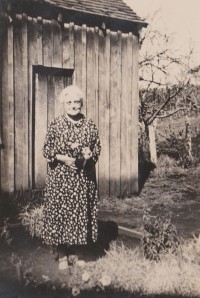
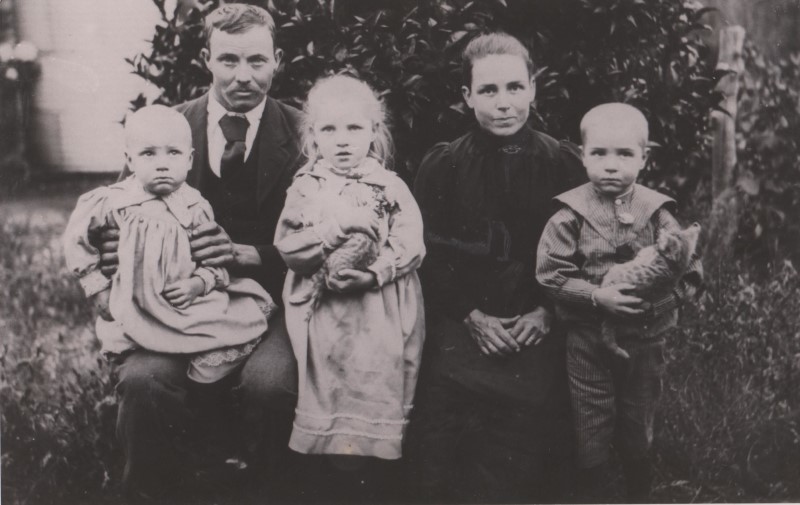
Jim Gardiner married Johanna Ali in 1895, moving to the farm Hill View, next door to Mountain Spring. Jim and Johanna had six children: Cecil (died as a baby) Elizabeth, Owen, Ralph, Albert and Johanna.
Aside from their farm house, there was another building at the homestead called “The Boys Room” where the Gardiner boys, and eventually some of the grandchildren, slept. The building had a wooden shingle roof, full of pin holes that let the light through but which was still waterproof.
In later years, the building was used to store apples, fruit, bacon, and dried meat including salami sausages.
The stables at Hill View were over the creek from the house. Sulky horses were kept in the stable, not the paddock and were fed chaff. The sulky was kept in good condition in case of emergencies or if a doctor had to be fetched.
Jim had worn grub hoes stored in one shed. They had been used for clearing land and gardening and were completely worn down but still kept, perhaps as mementos of the early struggle to clear farms.
From 1899, there was a train siding at the Nine Mile (now the corner of the Upper Ferguson and Wellington Mills Roads), built by the Canning Jarrah Timber Company, where farmers would pick up fertilizer from the mill train as it went back and forth between Dardanup and Wellington Mills. One Christmas Day at Jim and Johanna’s farm, Kevan heard the train travelling up through the Valley. The driver blew the whistle to wish everyone a Merry Christmas.

Jim Gardiner had a rifle in his hands most days of his adult life, an old Winchester single shot .22 rifle. He used about 500 rounds of ammunition a month to shoot kangaroos, rabbits and parrots. He would stand under a red gum and, seeing the outline of parrots, would pop them off. The Roads Board then would pay a penny a head to eradicate parrots (28s). Jim was an accurate shot. He would shoot and skin rabbits with a pocket knife and sell the pelts which returned good money at the time. Kevan remembers around 1943, as a 10 year old, going roo shooting with Jim Gardiner near Pigeon Springs.
Edgar Parkin credits Jim Gardiner with shooting the last dingo in the Ferguson area. At the time, dingoes had a £5 bounty on their heads, helping to eradicate them from the South West.
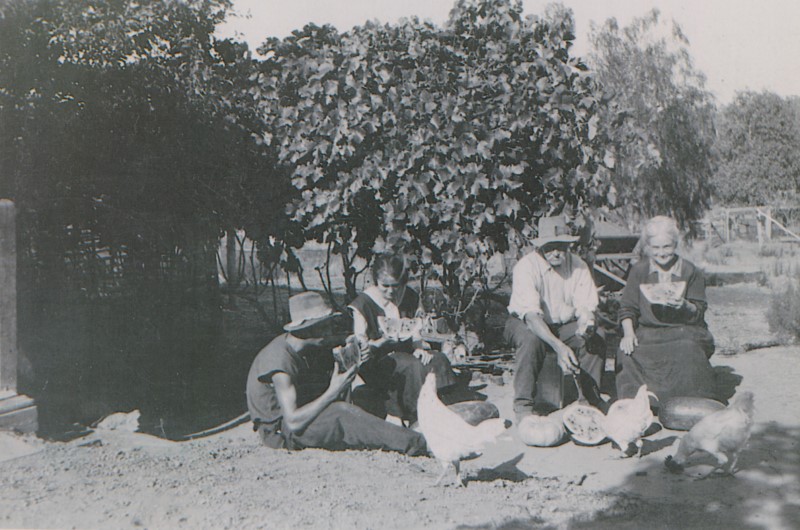
Jim Gardiner had a tin boat and dropped nets at the Wellington Weir to catch marron. He only kept the very big ones. Kevan remembers fishing with grandparents, Jim and Johanna at the Collie River near Hough’s Farm in the 1930s and early 1940s. This was then known as Waterloo but is now Eaton. He also remembers kids shooting a .303 rifle to stun mullet from trees into the water of the Collie River . After that time, pesticides and fertilisers killed off fish populations in the river.
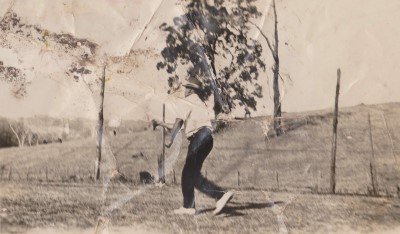
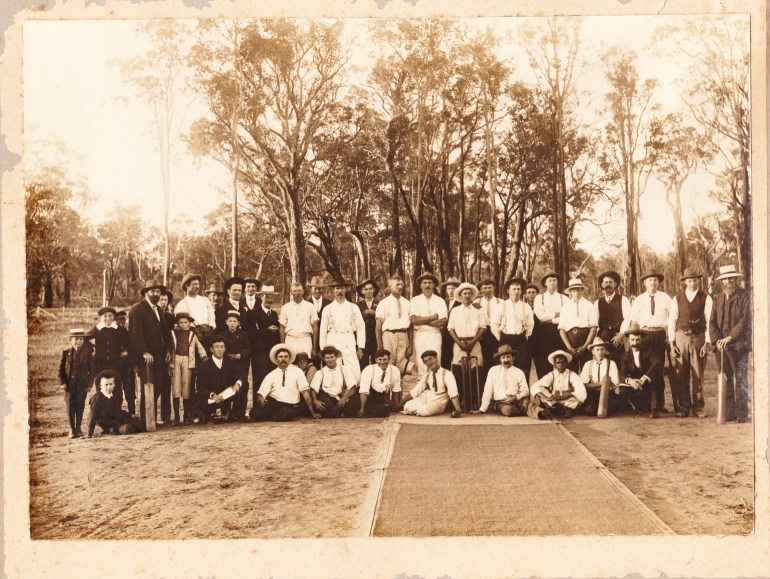
Local residents played tennis at people’s homes and the Ferguson Hall, and cricket with neighbouring teams. There was a tennis court at Mountain Springs, and the Gardiner family, including Jim, would play at Christmas time. The paddock was rough and the lines marked by applying lines of fertilizer.
There was no quick way to get to cricket matches. It sometimes took players up to two days travelling because of the time taken driving a sulky there and back. Jim’s horse knew the route home and if he returned at night, a lamp was used on the side of the sulky to light the way.
Three to four years before Jim died in 1950, he scratched his arm in the bush. The arm was infected for 18 months and he spent time in hospital bathing the affected area to encourage the skin to re-grow.
Ferguson farmers would meet once a week under a big nearby tree near Hill View to discuss farming and what was happening with the markets. These meet-ups took place under a large tree near Hill View, close to Ferguson Road. Kevan thinks it was a bushy marri just inside the boundary of Bert Kerr’s property, Swinton Vale, the farm next door to Hill View. Farmers would sit or lie under the tree and lean on their elbows to chat. Farmers Kevan remembers were Victor Gardiner, Jim Gardiner, Charlie Flynn and Guy Gardiner.
Jim celebrated 80th Birthday in April 1950 under the same tree. Jim passed away not long afterward on 9 August 1950.
[1] Tindale, Norman, Collection AA338 Norman Barnett Tindale, http://archives.samuseum.sa.gov.au/tindaletribes/kaneang.htm viewed 5 March 2025.
 Dardanup Heritage Collective