
by Thomas A Garbelini
4 June 2025
Some History of Dardanup from 1900 -1950
Stories and memories as told by my father, Domenic T Garbelini.
In the early day farmers had to clear the land by hand and using horses. Chaff cutting was the main way of making money. Chaff was sold to the Timber Millers of Wellington Mill and other areas that used horses to pull logs and other work. Chaff was also sold into the goldfields where horses were used. The horses were also a means of transport. The Fee Brothers and the Busher and the Harris families all grew oat hay to cut and be sold as chaff for horse feed.
Growing Potatoes was also another means of making money in those days. They were mostly grown on swamp land during summer months prior to irrigation system coming to Dardanup, and the winter crops were grown in the Ferguson hills.
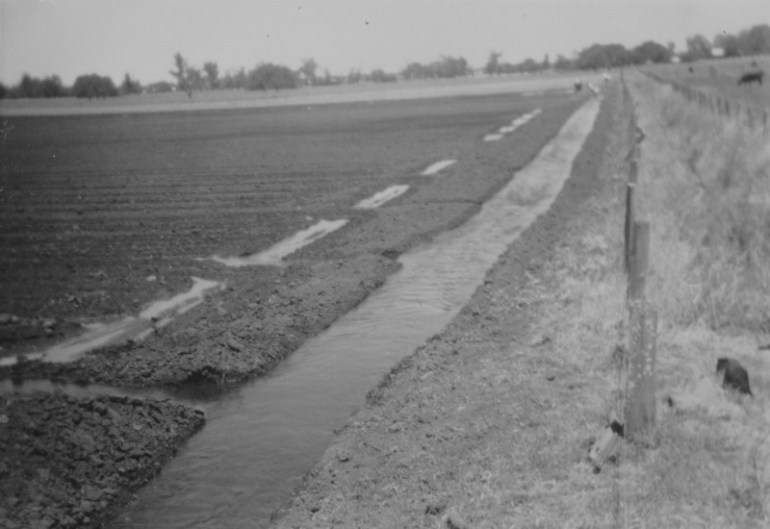
Irrigation was planned in the 1930’s, with water coming from the Wellington Dam. Channels were surveyed between1932 -1934. The government employed men to dig channels and erect bridges. In The Great Depression years of 1929 -1939, many people moved to the country areas working for farmers in return for food and housing. Some of the Italian migrant men were camped at the Dardanup Hall (the old Dardanup Agricultural Hall between the rail line and the South-West Highway) at the times of digging and doing channel work. The irrigation channels were dug by hand with picks, shovels and mattocks.
Source: Robert Garbelini
The Government paid these men to dig an allocation each week, which was easy for the Italian men, who dug theirs in three days and spent the rest of the week working for farmers clearing land for board and keep. The white-collar workers found it hard going and spent the whole week digging their allocation, 1 chain per week or 22 yards (20 metres) in old measurement. They were paid in food vouchers (value unknown).
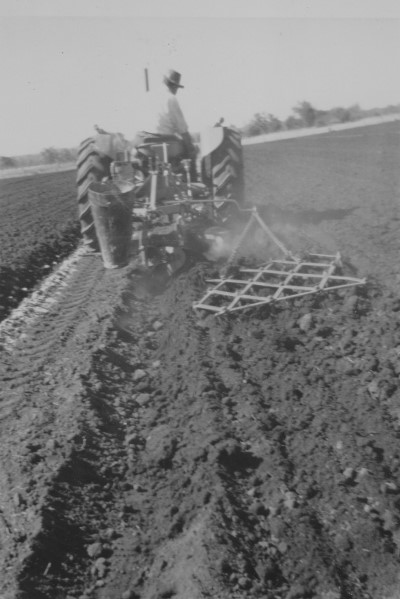
The Fee Diaries say that the first water from the Collie Irrigation Scheme reached Dardanup 25 January 1935 (Fee, G: Fee Diaries, 25 January 1935, p 461). Furrows were ploughed into the paddocks to allow the water to spread. With irrigation available potato growing became more widespread in the Dardanup area. Potatoes were grown in rows of four with a furrow between every forth row for the water to run down. They were irrigated about every 2 – 3 weeks. Digging the potatoes was done by hand, with a five-pronged fork. A lot of Italian and local men were employed to dig potatoes.
Source: Robert Garbelini
Italian men in Perth areas would contact Paul Italiano for work digging potatoes. They would arrive from Perth by train and Paul would pick them up in Bunbury, bring them to Dardanup where they would be accommodated and bring them to the potato fields where they were needed. Many could not speak English.
A story told to me by John Quici..he was picked up in Bunbury by Paul Italiano then taken to Dardanup to the potato patch and had never dug potatoes before. Paul handed him the potato digging fork and instructed him on how to use it. A few weeks later John asked Paul who was his fastest potato digger and how many bags dug in a day? John Quici wanted to beat the record so a competition was held and John dug 37 bags in a day against another unknown named person only achieving 35 bags. One bag of potatoes equalled roughly 30 kilo per bag and 16 bags of potatoes equalled about 1 ton.
In 1946 a Potato Board was set up to manage the supply of fresh table potatoes in Western Australia. Growers were given licenses, most between four and ten acres. With the irrigation system in place and Dardanup’s rich loam soil a lot of farmers acquired licenses to grow potatoes.
Some Italian families rented land to grow potatoes. Lots of sixty to one hundred plus acres were planted in the Dardanup area. During World War II, 1939 -1945 my father Dom Garbelini was recruited by the army and manpowered to grow potatoes and pumpkins for the army. The army gave him a two-ton truck, a Maple Leaf. He was given fuel and tyres for carting the potatoes and pumpkins to Perth Army Barracks, a four-hour trip, one way. By 1970 the water from the Wellington Dam became too salty to grow potatoes.
With irrigation the government introduced a milk quota system to supply fresh milk to the population all year round. Dad’s dairy was started in 1943. He bought eight milking cows from Barney Panizza, his stepfather, for a total of £38 ($76). He was selling cream to Sunny West Dairy Farmers. In 1949 he received his milk quota, Supply Number 16, from the Milk Board and he started supplying Browns Dairy at Brunswick Junction.
Irrigation Farmers were able to apply for a milk quota from the Milk Board. The government also controlled the price consumers paid for their bottled milk. The price farmers received was all on a percentage basis divided between the farmers, the manufacturers and the retailers. Farmers were offered a 45-gallon milk quota which they had to supply 365 days of the year. Many irrigation farms in the Shire of Dardanup owned milk quotas. About sixty dairy farmers owned a milk quota and made a profitable living out of the Dairy Industry.
In the year 2000 the Dairy Industry Quota System was deregulated and the price for milk paid to the farmers quickly fell below the cost of production. Today in 2025 we only have six working dairies left in the shire of Dardanup.
 Dardanup Heritage Collective