
By Royce White
Updated: 4 October, 2024
In about 1949, Joe and Madge White took up 450 acres of hill country on the Darling Scarp next to “Torch” Offers’ farm. The farm was located on what was then known as White’s Road but is now Henty Road. At the time, this area was regarded as Ferguson but is currently known as the locality of Henty.
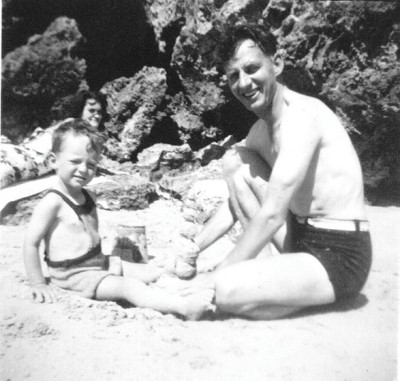
Joe had served in the 2/28 Battalion of the AIF in Tobruk and El Alamein and upon demobbing after the war, he worked in Albany for a short period before taking advantage of the War Service Land Resettlement Scheme.
This allowed the farm to be established to supply cream to a factory to be processed, house and the necessary buildings built and a milking machine to be installed.
I (Royce) was only about 3 when we moved into an old trapper’s house on Mr Offer’s property while our house was completed. My brother Stephen and sister Ruth were born during our stay on the farm.
Joe milked about 30 cows and the cream was sent to Peters Creamery in Brunswick. Peters still exists in 2024.
The dairy was equipped with several milking bails with a Petters 4 HP diesel driving a vacuum pump which supplied the pulsing milking cups.
The whole milk was then fed into a vat in the cream room where it was separated into cream and skim milk via a belt driven separator.
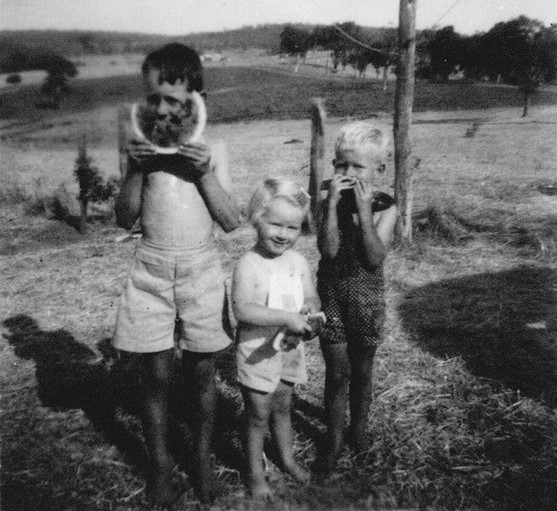
Originally our Petters engine drove a 32 volt generator feeding a bank of batteries. This was okay for lights, but not enough for Mum’s electric iron or for our 240 volt inverter which supplied the black and white TV.
So we had to run the diesel whenever we used those appliances. This meant someone going down to the engine room in the milking shed to turn off the engine!
The farm was originally milled for the jarrah so that when we came there was a lot of marri regrowth which I spent many hours ringbarking so as to allow pasture to grow.
We were fortunate as the property had several soaks which ran all year round and so obviated the need for water troughs for the animals.
We bought a Ferguson TEA20 tractor (commonly called a “Grey Fergie”) and several matching implements such as carryall, mower, buck rake, crane and eventually a post hole digger. The two furrow mould board plough was modified to penetrate much deeper in to rabbit warrens.
Rabbits at that time were a big problem as they multiplied quickly and ate grass so low that the cows could not reach the grass. One solution was to break up their warrens (holes) by multiple passes of the Fergie, criss-crossing the warren to make the soil powdery and impossible to create a burrow without collapsing. Although out of sight to us, the existing rabbits that were underground at the time of ripping were suffocated as the powdery soil collapsed on them.
Another method was the introduction of 1080 poison which was administered by impregnating it in oats via a narrow poison trail cut by a small disc into the soil near their burrows. This was achieved by free-feeding for a few days before the actual poison oats were laid. This was only done by an approved Agriculture Protection board Officer. Dad actually knew Arthur Tickner who laid the poison each year.
Dad was also involved in spreading the myxomatosis virus (also used to control rabbits) by setting up an enclosed area down near the river and infecting some rabbits.
But first we had to catch some live rabbits which were achieved using ferrets which were released into the holes to chase the rabbits out into nets. This method was reputed to be 98% effective back then.

Dad decided to switch to sheep which involved sheep yards, ring lock fencing (as the fence wires for cattle were to widely spaced), and a 240 volt shearing machine. I learnt to shear and crutch sheep which I also did around the district for a few years, but my tally was only about 100 per day.
We also built a plunge sheep dip to control lice, mites, ticks etc. This was an arsenic based dip which is now illegal.
We bought a gravelly hill block in the nearby forestry but did not develop it.
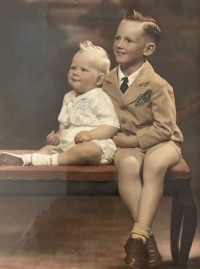
Stephen took up painting and Dad established the Wandjina Art Gallery in Bunbury where my sister Ruth worked. The need for picture framing material for Stephen’s pictures led Dad to Perth where he eventually took over a wood mouldings business and through a couple of changes ended up at 634 Hardey Road, Kewdale making a range of dowelling, architraving, skirting etc. and also acquired Lestan Industries.
These closed in 1980 and I became a full time mechanic, Stephen an investor and Ruth a gardener.
We had arrived at Steroy (named after Stephen and Royce) in about 1949 and sold out in about 1968.
I enjoyed my farm life and the unique experiences that if afforded me for life.
 Dardanup Heritage Collective