
by Margaret Vinci & Jenny Golding
Updated: 31 January 2026
Quick Links:
- Fir Park
- The Shivers’ Houses
- Kincora
- Fir Park worker’s cottage
- Craigie Lea
- Wandoo (Edwards)
- Harris house
- Kalamunda Farm (Gelmi)
If you have information and photographs of other homesteads or houses of interest in Waterloo, built up until 1950, please let us know by using the Contact Us page.
Fir Park
In 1886, Terence Hynes took up 1000 acres of land to begin farming, at Wellington Location 669 in Waterloo. It was around this area that a small rural community named Waterloo eventually developed.
He built a split jarrah hut with an iron roof and clay floor on this land.

At the age of 47, Terence married Mary Catherine (Kate) Dunne of Australind in 1897 and moved into Fir Park, the new home he had built 400 metres from the first hut.
Fir Park remains standing today.
The Shivers’ Houses
Below is a brief summary of this farm and homestead. For further information see: Arthur & Bridget Shivers
The Shivers family built two homes at Waterloo, the first in 1886 when Arthur Shivers, his wife Bridget and their family arrived from Ireland and bought property in Waterloo. This first home was of wattle-bough walls plastered with mud with a roof of thatch.
In 1898, prior to his marriage to Fanny Agnes Larkins, their sone Michael built another home, close to the first, this one of timber slabs and with an iron roof. The veranda gave added protection and shade.
Fir Park – Kincora
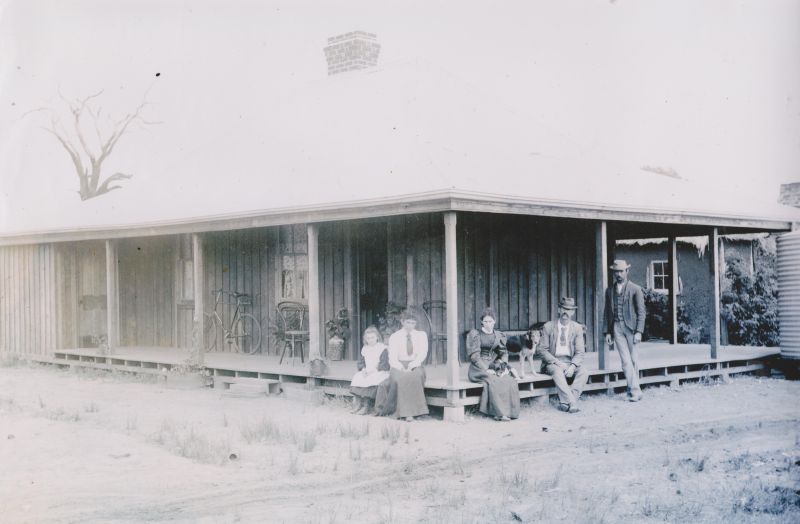
Kincora was originally a house on one of the group farms south of Busselton. The Hynes family bought it in about 1928. They numbered each board and transported it to Fir Park. Terence Hynes’ sons built it for their mother after the eldest son John Joseph was engaged to be married. It was at the centre of the farm opposite the Post Office and the original Hall. Catherine (Kate) lived there with her son Laurie until a couple of years before her death in 1946. Laurie continued to live there and married in 1946. Laurie and his wife Thelma lived at Kincora with seven of their children until 1959 when he built a new home on the Bunbury section of Fir Park. The house was demolished in the 1960s.

The photograph above shows Percy Edwards and Laurie Hynes leaving Kincora for the Edwards’ cattle drive to Lake Preston, stopping overnight at Belvidere camp site (still visible) and arriving at Lake Preston the next afternoon. The Harris family would also do this trip, but only to Belvidere. Sometimes the two droves met and it was hard work to keep them apart. This is when Jim Depiazzi would show his skill in cattle horsemanship, an excellent team of man and horse.
Fir Park – Worker’s Cottage

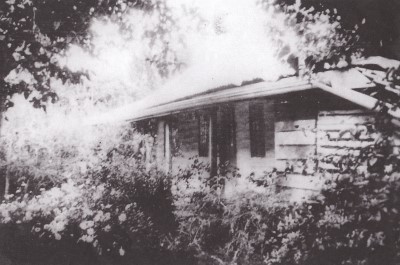
The Dunne family home was originally the West Australian Company’s office at Australind.
After the company collapsed, Patrick and Mary Dunne (who had arrived at Fremantle aboard the Emma Eugenia on 25 May 1858. with their daughter Anne) were able to use the Company’s empty Office, which they moved into as their family home. It was situated on the corner of Paris Road and the Old Coast Road, just down from Henton Cottage, near what is now the Australind Shopping Centre. The Dunne’s added a brick kitchen, fences and a shed and planted fruit trees, grew a large vegetable garden, and planted plantains. After 13 years of making his home improvements, Patrick Dunne was granted the title deeds to this land. Later, the Dunnes used the shed as a general store, where they sold and traded goods. These included eggs, vegetables, fruit, mutton, nails, lighting oil and other products. Over the years, they purchased more land, with their son John Dunne, eventually owning 1300 acres.
Craigie Lea
Below is a brief summary of this farm and homestead. For further information about the home and family see: Craigie Lea
Frances and Emma Craigie and eight of their nine children settled in Waterloo in 1889. They initially lived in three tents erected on the uncleared timber and bush-covered land.
The first house on the property took twelve months to build and was completed in 1890. It was constructed of pit-sawn jarrah boards and faced onto what is now Dowdell’s Line.

This first Craigie Lea home consisted of two large rooms and a veranda, corners partly enclosed, the whole sheltered by an iron roof. A kitchen/living room was separate in case of fire and a separate bread oven was already in use.
The jarrah home was deeply appreciated by Emma because of the cold and wet conditions that prevailed in Waterloo in winter. Other homes were built as the sons married.
Wandoo – Edwards’ House

Harris’ House
This home was built by Thomas William Harris at the corner of Wireless and Harris Roads. He served as Dardanup Roads Board Chair between 1905 and 1910.

Kalamunda Farm & The Gelmi House
Below is a brief summary of this farm and homestead. For further information see: Kalamunda Farm
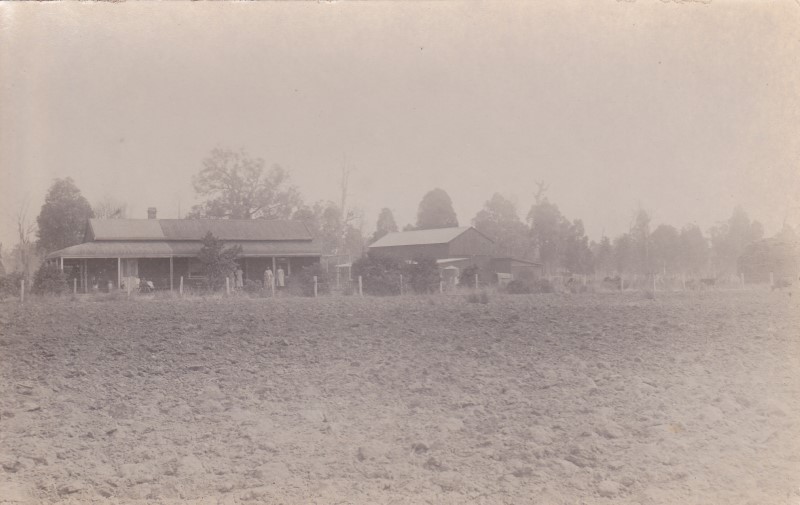
Hard-working Domenic and Maria Gelmi and their son, 12-year-old James, moved from their dwelling in the forest at Shotts, near Collie, to a large but unfinished river-side home in Waterloo in 1927. They had only recently bought the 40-acre block on which the house stood but had been farming their adjoining 100-acre property for many years whist living and working in the mining industry. Kalamunda Farm was the name chosen for their home and land.

The large, unfinished house on a forty-acre block, adjoining the Collie River, was bought by the Gelmi family in 1927.
Pig sties drained to the river and pines trees grew in front of the home. Source: Joanne Gelmi
With thick walls of river mud, the house consisted of nine or ten spacious rooms but lacked ceilings under the iron roof. Floors were of timber and the main room, graced with the only smooth floor in the building, soon became a gathering place for musical evenings and dances, family celebrations, neighbourly get-togethers.
The Gelmi family felt that the home was always meant to be grand in stature and knew that it had been built for Bunbury businessman and Waterloo farmer, Henry (Harry) Belcher and his wife Florence. It had been sold to William Chalinor, another Bunbury businessman/farmer, who may have added to the structure.
A piggery was in front of the house and the Italian sausages, bacon and ham produced hung, along with onions and cheeses, on wires across the room. Grandson Alan Gelmi made the comment: “The aroma was indescribable.”
The home was lived in by, James and Eileen and their four children, Barrie, Neville, Alan and Marie. Later, Neville and his wife Jennifer (nee Gardiner) lived in the house, but the crumbling home eventually became too expensive to maintain and was dismantled. The pines, planted in very early days, lived on for many years.
References:
- Information and photographs for:
- Fir Park, Kincora, Fir Park worker’s cottage, Wandoo and the Harris homesteads were provided by Margaret Vinci.
- Kalalamunda Farm & the Gelmi House was taken from:
- Interview Maria Gelmi by Jenny Golding
- Gelmi family interviews
- Alan Gelmi notes
- Black and white photo was sourced from Joanne Gelmi
- Craigie Lea:
- Information provided by Jenny Golding,
- Photograph provided by Thelma Kemp
- The Shivers homes:
- Information and photograph provided by Jenny Golding
 Dardanup Heritage Collective