
by Janice Calcei
Updated: 27 January 2024
If you have information and photographs of other homesteads or houses of interest in Ferguson, built up until 1950, please let us know by using the Contact Us page.
The following homesteads will be completed as information becomes available:
- Greenwood (Gardiner’s)
- Mountain Spring (Gardiner’s)
- Hillview (Gardiner’s)
- Maxicar (Dr Joel’s)
Blackberry Valley Farmhouse (Gardiner’s)
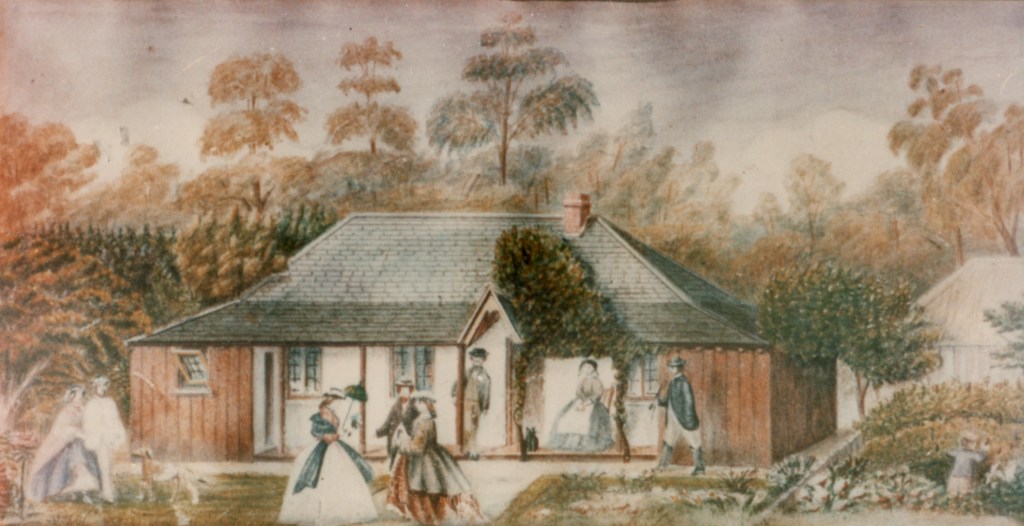
This house was built by Jesse Gardiner in about 1850 when he arrived in Ferguson. It was built of timber slabs and clay. The painting below depicts a scene from those early times depicted by Thomas Henry Johnson Brown who was a school master at Ferguson about 1865.
Jesse, his wife Jane and their four children had arrived aboard the Trusty on 6 December 1842 to join the Australind settlement near Bunbury. After this land scheme failed to take off, Jesse worked for Marshall Waller Clifton, then on his own land in Brunswick, and finally he took up land in Ferguson. The original homestead was replaced in the early 1900s by a more modern building, Greenwood, built by Jesse’s youngest son Ephraim.
Melburnup
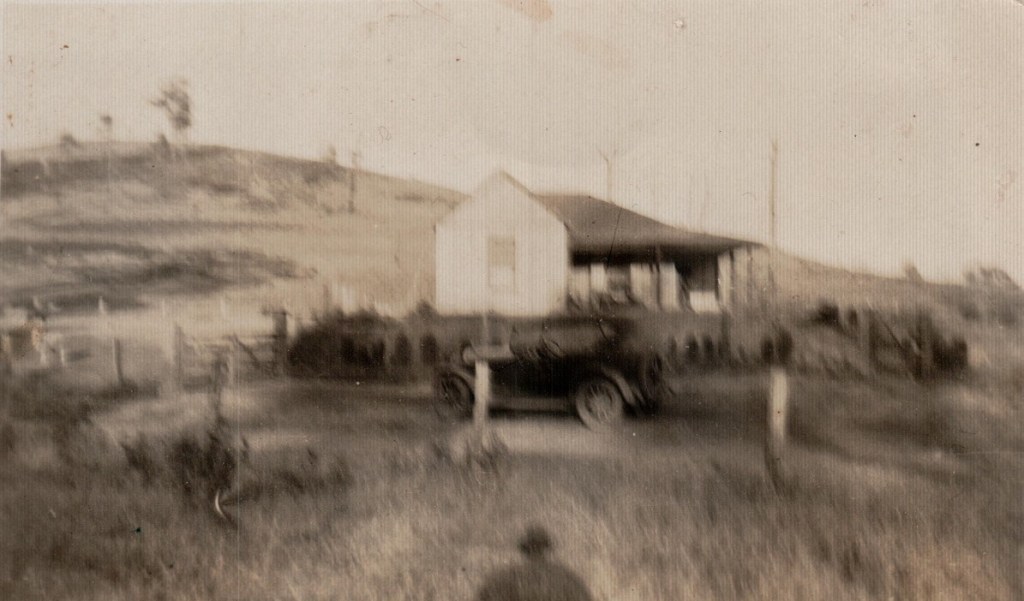
The homestead Melburnup was built by J J Chapman in 1910 on a farm of 500 acres in Ferguson. The farm was then purchased by J C Kerr in about 1925. The land was later sub-divided into Melburnup and Swintonvale and taken up by J C Kerr’s sons. Bob Kerr took Melburnup and Bert Kerr lived at Swintonvale.

Melburnup homestead was demolished in the early 1970s.
Mr. J. Chapman’s House Warming – On Friday, the 7th inst., Mr. J J. Chapman, who has built a beautiful house, gave the children and people of the Ferguson a house warming, and everyone had a splendid time, dancing for those who prefer it and card playing for the older people, and at midnight all sat down to an excellent supper, which I need not say everyone did full justice to.
Southern Times, Thursday 13 October 1910, page 3
All present were loud in their praise of Mr. and Mrs. Chapman for the royal manner in which they treated everyone, and all joined in wishing that Mr. and Mrs. Chapman would long be able to enjoy the new house and that they would have a long and prosperous life.
Marlborough Farm (Bocker’s)
There is currently no photograph of this home available. It is believed to have been opposite Greenwood, and on the river west of the Ferguson Church. The building no longer exists.
One of the prettiest homes on the Ferguson is Mr Bocker’s. The house is built of local stone, with brick facings, is pleasing to the eye, and is the style of building warranted to stand for centuries. The adjacent orchard is young and vigorous, and although only a few acres in extent, is of better quality than many a larger but not so well tended orchard. Nearer the town Mr Bocker is calling into existence a strawberry plot, and having the genius for work, he has every prospect of achieving success from the experiment.
Bunbury Herald, Monday 5 March 1906, page 2
Sargeant Dale Farm (Fowler’s)
This farm was established on the Ferguson River in the 1870s by John Charlton Fowler on Wellington Location 542. His parents, John and Elizabeth (nee Dicey) Fowler had worked for Thomas Little and it was at Dardanup Park that John Charlton Fowler was born on the 7 May 1849, their fifth child.
The large barn that John Charlton Fowler built beyond the home is the only original building remaining on the property today.
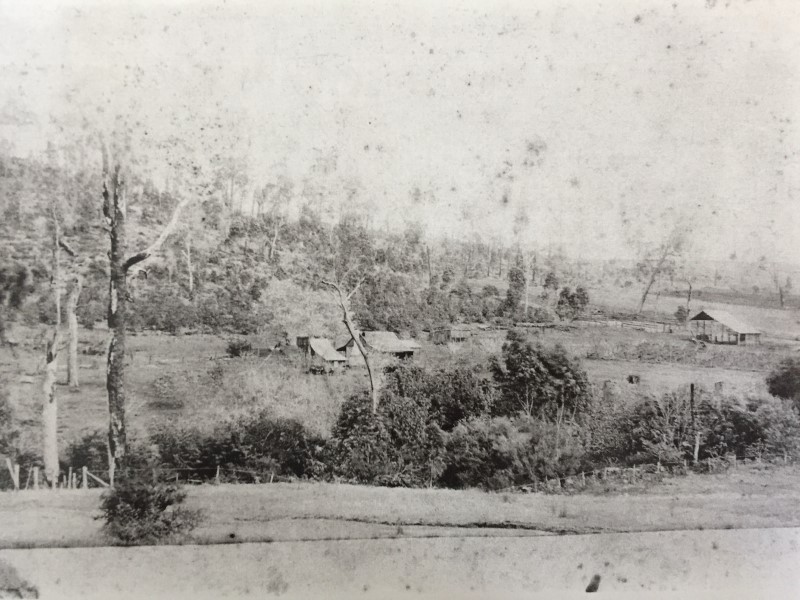
Sargeant Dale farm was situated along what is now Wellington Mill Road. The property remained within the Fowler family until the 1970s.
The homestead is always in process of evolution and grows in size by expanding wings and an addition to its length every ten years. You look from one room into the other through the window which once gave light to the original building but is now useful to hear what goes on in the next room. The house is a castle of freedom, and the social life in its borders is natural and without restraint.
Bunbury Herald, 31 August 1906 – Sergeant Dale – A Ferguson Farm, p 3.
The farm, itself, consists of some thousand acres of land and rocks. The uplands are well grassed, and the valleys, in some instances, are not “clothed with corn,” but the common fern maintains its hold of the best country. Some 400 sheep are depastured in the paddocks and constitute the best asset on the financing side. The orchard is well developed and consists of an admixture of fruits of various varieties. The apple grows to perfection, and the Cleopatra, Dunn’s seedling, Jonathan and a dozen other varieties tempt the taste of the epicure, and solidly satisfy all they whose souls hunger after apple. The orange trees have been planted so close together that from the house they look like one massive tree; the fruit they bear is of good quality, but the red scale holds sway and detracts from the look of the fruit.
Brookfield Farm (Flynn’s)
This property, 150 acres at Wellington Location 338, was granted as a tillage lease to Henry Stanes Flynn in 1876. The land was subsequently mortgaged but, unable to repay the loan, the land was lost in March 1878. In 1882, eldest son John repurchased the same property. (Source: Memories of the Ferguson, Flynn, pp. 25-26). Ownership continued in the Flynn family until the late 1950s or early 1960s.
The original house no longer exists. The property has been planted with vines and is currently the site of Hackersley restaurant.

Brooklawn Farm (Slattery’s)
Brooklawn Farm was owned by Patrick and Rose (nee Hanlon) Slattery in Ferguson. The house was on the flat near the corner of Ironstone Road and Ferguson Road. There are no known photographs of the home.
Patrick Slattery was a convict who arrived in the Swan River Colony on August 31, 1853 on the Phoebe Dunbar. He was granted a ticket-of-leave on August 24, 1854. It is probable that in the mid 1850s, Patrick was an employee and tenant of Thomas Little, a prominent landowner in Dardanup.
Rose was the daughter of Bernard Hanlon, a farmer of County Tyrone, and his wife Catherine Slavin. Rose arrived in the colony in 1858 on the ‘Emma Eugenia’ and married Patrick on the 16th of May, 1859 in the Church of the Immaculate Conception, Dardanup.
While living in Dardanup, in the mid 1860’s Patrick applied for 40 acres of Crown land in the Wellington district. In the 1870’s Patrick began to build up his landholdings by taking out special occupation leases. Eventually, the large Slattery family moved to Upper Ferguson.
On January 4, 1905, Rose Slattery died aged about 65. She was a deeply religious woman who had played a big part in educating her children.
On August 20, 1915 Patrick died of a heart attack aged about 86. He had gone for a walk after tea along the railway line and collapsed where it crossed the Ferguson River. He was buried at Dardanup Cemetery.
Patrick’s sons took over the farm at Ferguson and in 1929 the old house was pulled down. Patrick and Rose were survived by seven children, 30 grandchildren, and 90 great grandchildren.
Click here for more information about Patrick and Rose Slattery.
Swintonvale (Kerr’s)
Swintonvale farm was sub-divided from 500 acres bought by John Calvert “JC” Kerr from J J Chapman, Melburnup, in about 1925. JC’s son, Bert Kerr, lived there until his death in 1972. Bert’s nephew and wife, Maxwell and Rosemary Kerr then took over the house and farm. At that time, the old kitchen still had a dirt floor. A modern kitchen and bathroom were added at the back of the old cottage. Swintonvale was sold by the Kerr family in 2023. Swintonvale house is currently still standing.
 Dardanup Heritage Collective